Monday, January 6, 2014

Seeds Have Arrived!

SEEDS HAVE ARRIVED!

I went down to the store with the kids a couple mornings back to check on the seeds I sowed recently.  When I arrived I found a box outside.  It had been in the below zero temperature all night long.  It was some of my recently ordered seeds from +Harris Seeds !  I was not concerned about the box being in freezing temperatures all night as long as the box was not wet.  I brought the box inside to begin my inspection.


Everything is dry, just extremely cold!  It's so exciting!  I want to sow them now and see them grow but it's too early.  Let's look through them and see what types of seeds I ordered from Harris.
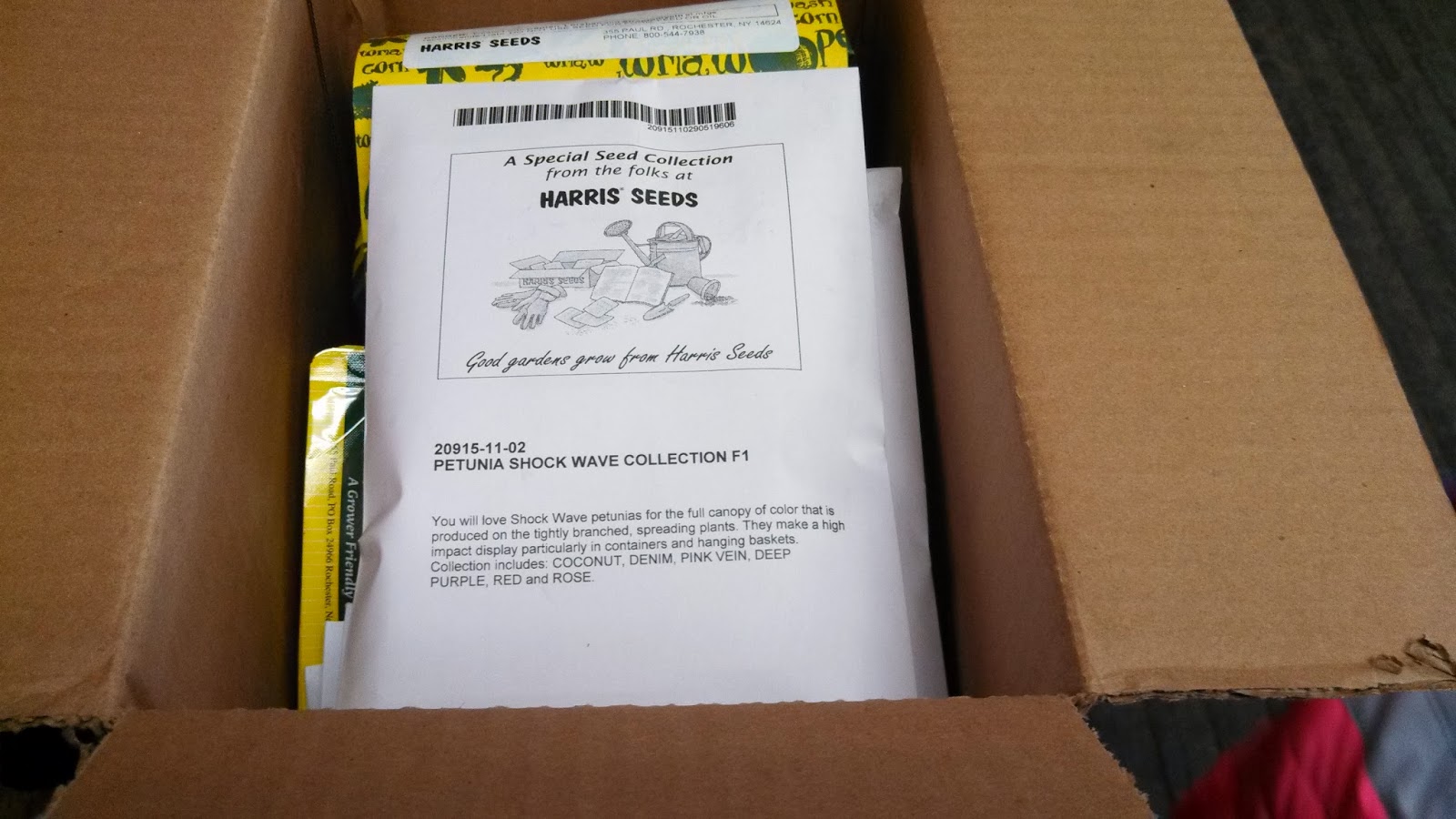

The packet on the top is a sampler of Petunia seeds called Shock Wave Petunias.  I have never grown them before but my father had luck with them last season so I wanted to give it a shot.  If you have ever heard of or purchased regular Wave Petunias then you will have a good idea what the Shock Wave petunias are all about.  The flowers are petite and very similar to a Calibrachoa (more on those in a later post) flower but they have the same growing and spreading habit as a Wave Petunia.  If I recall there are 50 seeds each of 6 different colors in this sampler pack.


My 3 year old daughter Abigail was also very excited about my new seeds.  A future horticulturalist in the making?  Only time will tell.


One of the other new varieties I received was one of the Marigold Cresta series.  This is Marigold Cresta Spry.  Sorry for the shaky photo.  I ordered this one because for whatever reason the Marigold Boy Spry seed has been discontinued.  This happens in the world of plants and seeds.  There are trends like anywhere else and apparently the Boy series isn't as cool as it once was.  I imagine that within the next couple of seasons that the Cresta series will completely replace the Boy series.  Keeps me on my toes.


Finally this one is being hyped in all of the seed catalogs and it won a 2013 All-America Selections award so of course I had to try it.  This is Canna South Pacific Scarlet and what is unique about it is Cannas don't typically grow from seed but from underground stems known as rhizomes.  While this is a tropical plant and shouldn't be treated as a perennial in New York where I am from, apparently it is a bit hardier than your typical Canna.  I'll go more in depth with this one when I sow it.  From what I have read I will not be able to sow the seeds in my 406 cell tray because when they germinate they will push themselves out of the cell!  I'm thinking I'll sow them in the 50 cell trays I used recently for the Penstemon and Coreopsis.


Speaking of those, I don't see any germination yet.  It hasn't been long so we'll give it some more time.

Thanks for reading.  I'm looking forward to taking some Lamium cuttings next time.


Sunday, January 5, 2014

Sowing the First Seeds of the Season

SOWING THE FIRST SEEDS OF THE SEASON

It's always exciting for me to sow seeds that, with patience, will grow into adult plants and make a customer's garden beautiful.  It just amazes me that all the genetic material it takes to produce these plants is stored in these tiny seeds.  But I'm not here to give you a lesson in biology, suffice it to say that life in all forms is amazing.

With that being said I usually order my seeds for the following season shortly after Christmas.  I usually order seeds from several companies but the ones I like are Vis Seed (but don't order your seeds off their website.  It's not up to date!) , Harris Seed, Twilley Seed, HPS Seed, and Stokes Seeds.  Vis has by far the most reasonable prices but heed my warning about their website.  However at the time of this writing my new seeds have not arrived yet.  So I look at last years leftover seeds for anything I can sow to pass the time.


Look at that!  Coreopsis and Penstemon seeds!  These are perennial plants and sowing them this early in the season will give them the head start they need.  It's much too early to sow any annuals yet, but before you know it I'll have the johnny jump-up and pansy seeds out.  But how many seeds are left over?  Unfortunately not many.  Certainly not enough seeds to sow them in a 406 cell seed tray I would typically use.  So I decided to sow them in 50 cell trays that our mums and other plugs come in.


I don't even bother using my germination mix (soil).  I just fill the trays up with our normal everyday potting soil.  Oh wait I'm forgetting something.  Seeds like additional heat in order to germinate.  I need to turn on the heat table!

This is the hot water heater that heats the heat table.  That's using the word "heat" way too many times in a sentence.  Oh well. 


The pilot is still lit from last spring when I turned it off.  Bonus!  No need to light this baby.  Now I just have to turn it up to hot, turn the control unit up to 70 or so, and turn on the valves for the pipes that run under and through the heat table.  


That was easy.  After sweeping out the leaves and debris that is always collecting under the heat table I am ready to sow my seeds!


I'll start with the Penstemon.  Wow these are really tiny seeds.  I would normally use my seeding machine that uses a vacuum to hold the seeds in place, but since I'm not using the 406 tray it would be pretty pointless.  I just need to pick up these tiny seeds with my fingers and try to drop them one at a time into the soil.


First I make a slight indentation in each cell with the butt end of a dibble.  I'll drop the seeds one at a time into these cells.  I ended up filling about 45 out of the 50 cells with Penstemon seeds.


These seeds need darkness to germinate so I'll cover them with a thin layer of fine vermiculite.


 All done!  I put the tray on the heat table and staple a plant tag to the tray so I remember what is growing here.  By the way this particular Penstemon is Tubular Bells Wine Red/White Throat.  It is actually a tender perennial in my neck of the woods but maybe in your zone it is a bit hardier.  These plants have sold well for me at market but I decided to cut back this year so I didn't order any new Penstemon seeds.  So these are it.  I hope that most of them germinate.  Let's do the Coreopsis now.


Wow I'd be lucky if I had about 20 of these Coreopsis Presto seeds.  That's okay because I have 100 more on order.  Last year I grew too many and ended up throwing them away so again I am trying to cut back.  There is only so much you can do each season.

Following the same procedure I used for the Penstemon seeds I am able to complete sowing the Coreopsis seeds.  I ended up sowing about 30 of them.  Not bad.  Now I lightly water them and that's it.  It might take up to a couple weeks for them to germinate.  I just have to water them everyday and hope for the best.

I'm really looking forward to receiving my new seeds and sowing more!


Saturday, January 4, 2014

Jade and Aloe Plants

JADE AND ALOE PLANTS

During the down time between Christmas and when our store re-opens in early January there is still clean up work to do, but once that is finished I like to "tinker" in the greenhouse.  One of the things I usually do at this time is propagate my jade and aloe plants.  These are the parent plants below that were given to me by dad's brother Uncle George.

I only propagate about 15 of each because they're really not the best seller.  If they sell well then I can always do more.  I start with the jade plant and with a pair of sharp scissors or a knife cut off about 3 inches or so from anywhere on the plant.  I try to make the parent plant look balanced so I'll cut it wherever it looks like it needs a haircut.  Once I've separated it from the main plant I remove the bottom 3 or so set of leaves.  This is the part that will go in the soil to form roots.
 
  
Then all that's left to do is push it into the already moistened soil up to the point where I stopped removing the leaves.  That's it!  I've read that it helps to use some sort of rooting hormone on the part that goes in the soil but I have never done that and my jade plant offspring always grow without a problem.  


I like to use a 3.5" pot for growing my succulents.  It's the same type of pot that we grow herbs in later in the season.


Once I've planted all 15, I insert the plant tags with the description of the Jade plant and the scientific name Crassula Argentea.  I don't water them because, as I've already mentioned, the soil was semi-wet before I started and also because succulents store moisture in their leaves and don't need a particularly large amount of water.  In fact being too wet will actually damage them (as it will most plants).


These Jade plants make wonderful houseplants.  They are very slow growing but live for several years.

Now onto the Aloe plant.  This is a bit of a different procedure as I'm actually not cutting anything off of the parent plant because Aloe can self propagate.  In fact they are so good at it it's almost a nuisance.  I take the entire (very heavy) plant out of it's container and you will see all of the baby plants growing from bulbs that that the parent plant has already done all by itself. 


There is way more than the 15 plants here that I require, but I chose the ones that are not too big (for a 3.5" pot) and not too small.  On this particular Aloe plant I have to watch out because some of the leaves have become rotten.  This is due to being watered and getting the leaves wet.  They don't like that, especially in conditions where the water does not evaporate rapidly enough.  I either avoid those bulbs or carefully peel the leave off.


Once my 15 Aloe offspring have been selected, it's as easy as making a small hole in the soil with my fingers, inserting the new plant, and packing it in the soil.  Again, this is a succulent so the soil does not require any water at this time.  In fact I won't give these any water for a week and when I do it will be very little.


Now I simply wait for the Jade plants to root (takes several weeks) and the new Aloe plants will begin making their own offspring before you know it.

Thank you for reading my post about succulents.  Have a great day.

Introduction

INTRODUCTION


Hi there.  I'm Benjamin Brizzell.  I usually go by Ben but you can call me Bronco if you like.  I help to run a farm market and greenhouse business that my parents founded way back in 1974.  One of my main responsibilities at the business is to take care of the greenhouses.  That is growing the plants, sowing the seeds, eliminating pests, doing repairs and maintenance, and anything else you have to do to keep a greenhouse running.

I thought it might be fun to share the work I do in the greenhouse in this blog.  I don't know if I'll be able to keep up with this moving forward in the season but I figured in January while there's not much going on I might as well give it a shot.  If you're reading this I'd like to thank you for being interested in what I have to say.